DevSecOps · Infrastructure automation
Infrastructure that changes only through reviewed code
We write your infrastructure as Terraform modules, post the plan to every merge request for review, and let only the pipeline apply it. A scheduled plan reports drift, so a change made by hand is found rather than inherited.
The problem
Where this usually breaks down
Changes made in the console
Someone fixes an incident by hand in the portal, the code no longer matches the estate, and the next apply quietly reverts the fix or fails halfway.
One state file for everything
A single Terraform state for the whole estate locks every team on each change. Plans grow too long to review properly, and one mistake can reach everything.
Copied code between environments
SIT, UAT and production are separate copies of the same code, edited apart. They drift a little with every change until nobody trusts UAT to predict production.
What we do
What we set up, and how each part works
We work in your repositories and through your change process, so everything we set up can be reviewed, run and changed by your engineers after we leave.
Versioned modules with clear interfaces
We write Terraform modules for networks, clusters, identity and workload baselines, each with typed inputs, documented outputs and a version tag. Environments consume released versions, so an upgrade is a reviewed change rather than a surprise.
The plan reviewed on every merge request
Every merge request runs the plan and posts it for review, with policy checks against the planned changes. Reviewers see exactly what will be created, changed or destroyed before anything is approved.
Applies only from the pipeline
Only the pipeline applies, under an identity with the permissions it needs and no more. People keep read access and a logged break-glass route, and the change history lives in the repository.
State split along ownership lines
Remote state is split by environment and by the team that owns each layer, with locking and restricted access. SIT, UAT and production use the same modules with different values, not different code.
Scheduled drift detection
A scheduled plan runs against each environment and raises a ticket when the estate no longer matches the code. The owner then either adopts the change into code or lets the pipeline revert it.
Compliant VM templates as the default
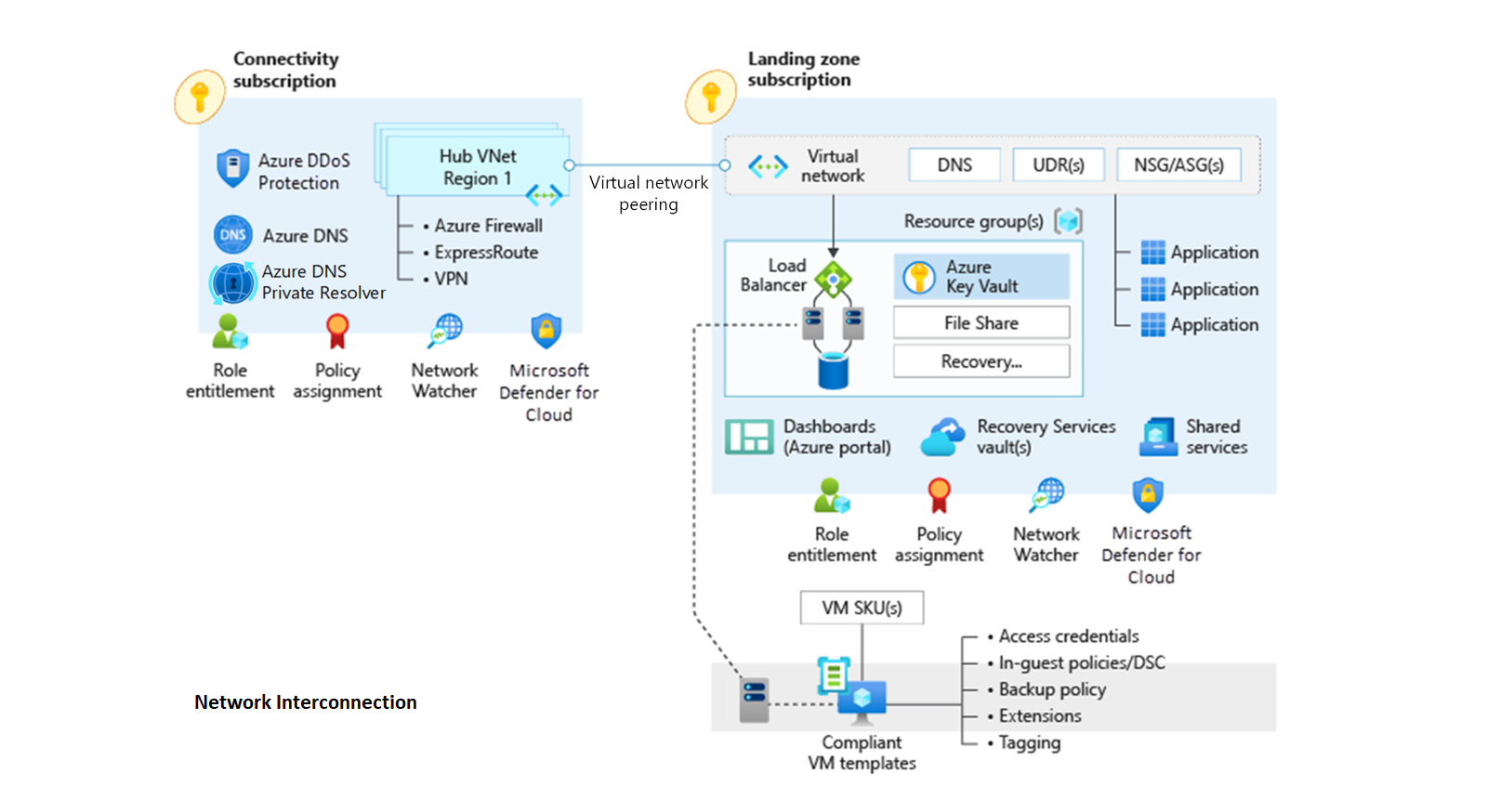
VM templates fix sizes, extensions, backup, tagging and in-guest policy, and Kubernetes deployments use Helm charts with the same defaults. Following the template is the easiest route to a compliant resource.
Reference architecture
The architecture as it was delivered
Figures from published engagements, reproduced unchanged. Open any figure full size, or read the write-up it comes from.
- Read the write-up: A governed Azure foundation a bank could build on
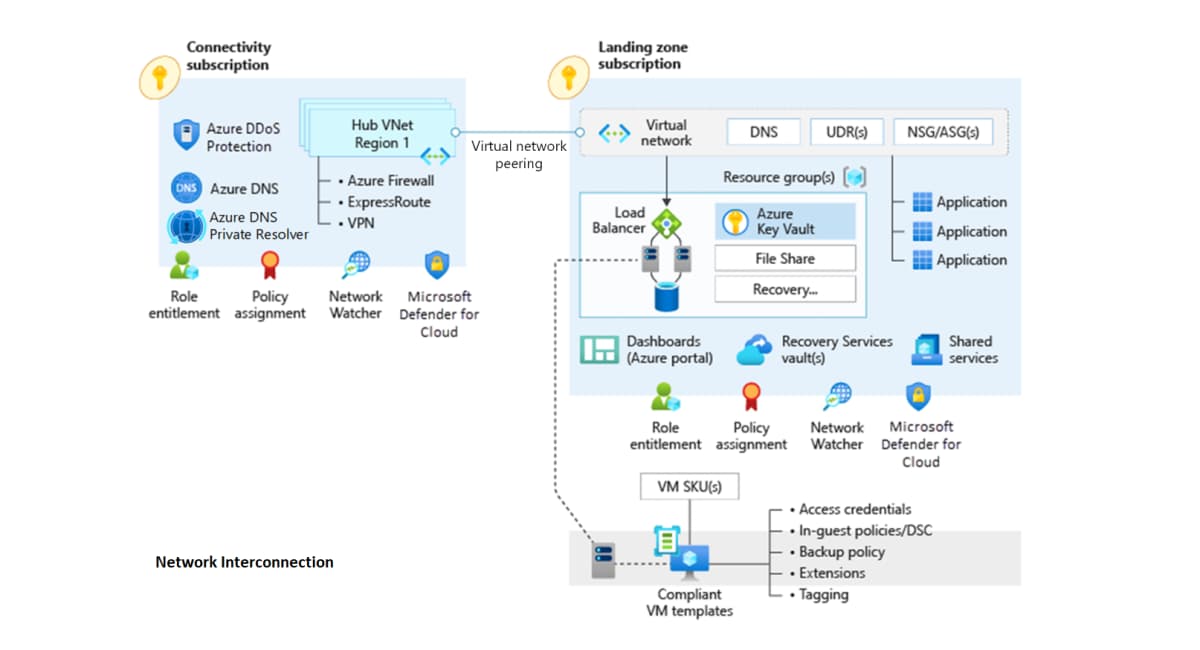
Figure 1 — Hub-and-spoke interconnection between the connectivity subscription and an application landing zone, including the compliant VM template baseline every workload inherits.
Open full-size image: Figure 1 — Hub-and-spoke interconnection between the connectivity subscription and an application landing zone, including the compliant VM template baseline every workload inherits.
What you keep
What stays with your team when we finish
Everything is committed to your repositories or written into your documentation, under your access controls. Nothing depends on us to keep running.
A module library in your repository
Versioned Terraform modules with examples, tests and a changelog, which your teams consume by version and extend through merge requests.
Environment configurations per layer
The root configurations for each environment and layer, with remote state, locking and access set up and documented.
Pipelines for plan and apply
The pipeline that plans on every merge request, applies on approval under its own identity and runs the scheduled drift check.
Runbooks and decision records
Decisions on module boundaries and state layout, and runbooks for drift, state recovery, module upgrades and break-glass changes.
How we work
How an engagement runs, phase by phase
Each phase ends with something your team reviews and signs off before the next one starts. We work inside your change control, not around it.
01
Inventory what exists
We catalogue the resources that exist today, which are already in code, which were created by hand and how state is held. Critical resources get an import plan before anything changes.
02
Design modules and state layout
We agree the module boundaries, the state split and the review rules with your platform team, and write each decision down with the options set aside and why.
03
Import and prove one environment
Existing resources are imported into code for one environment first, and the plan must show no changes before the pipeline takes over applies there.
04
Extend and hand over
The same modules roll out to the remaining environments, with your engineers writing the changes and ours reviewing them. By the end, your team owns the modules, the pipelines and the drift process.
Technology
The tools this work runs on
Each group says whether a tool appears in our published work, so you can tell what we have shown from what we offer.
Run in production
- Terraform
- Azure
- Azure Pipelines
- Azure Repos
- GitLab
- Kubernetes
- Helm
Offered, not in published work
- Azure Policy
Evidence
Published work behind this service
Each statement below points to a write-up you can read in full, with the architecture and the stack as they were delivered.
For a bank’s Azure landing zone, we prepared the Terraform templates and the pipelines in Azure DevOps that deploy them, making the pipeline the only route for changing a control.
On a DevSecOps platform, we used Terraform to provision the infrastructure beneath Google Kubernetes Engine, with Kubernetes manifests and Helm charts describing the more complex deployments.
Questions
What teams ask before we start
We already have Terraform written by several teams. Do we start again?
Rarely. We review what exists, keep the modules that are sound, and refactor the rest behind stable interfaces. State follows with import and moved blocks, so resources are re-homed in code without being destroyed and recreated.
Does this work with the CI system we already run?
Yes. The plan, review and apply steps run in GitLab, Azure Pipelines, Jenkins or GitHub Actions. What we insist on is that the apply runs only from the pipeline, under an identity your team controls and can audit.
What happens when someone changes a resource by hand?
The next scheduled plan shows the difference and raises a ticket for the resource owner. They either write the change into code, if it should stay, or let the pipeline revert it. Emergency changes remain possible through break-glass access, and are reconciled afterwards.
What access do you need to our environments?
Read access for the inventory. During the build, we propose every change as a merge request, and your pipeline applies it under an identity you own. Nothing reaches your environments outside your own change process.
Who owns the modules after handover?
Your platform team. The modules, root configurations, pipelines and runbooks are in your repositories from the first commit, and your engineers publish new module versions themselves. We can stay on as reviewers, but nothing depends on us.
Related services
What teams often need alongside this
CI/CD pipelines with enforced gates
Pipelines that run unit tests, SCA, SAST, quality and image scans in cost order, and send every failed gate to the team that owns it.
Azure landing zones
Azure landing zones in Terraform: management groups, policy at scale and a hub-and-spoke network that every subscription inherits.
Cloud-native DevOps on Kubernetes
One image built per change, Helm charts per service, and a GitOps controller that promotes it from SIT to UAT to PROD on Kubernetes.
Next step
Plan your infrastructure as code with us
Tell us what is in code today, what is not, and how changes reach production. We will suggest where to draw the first module and state boundaries.